
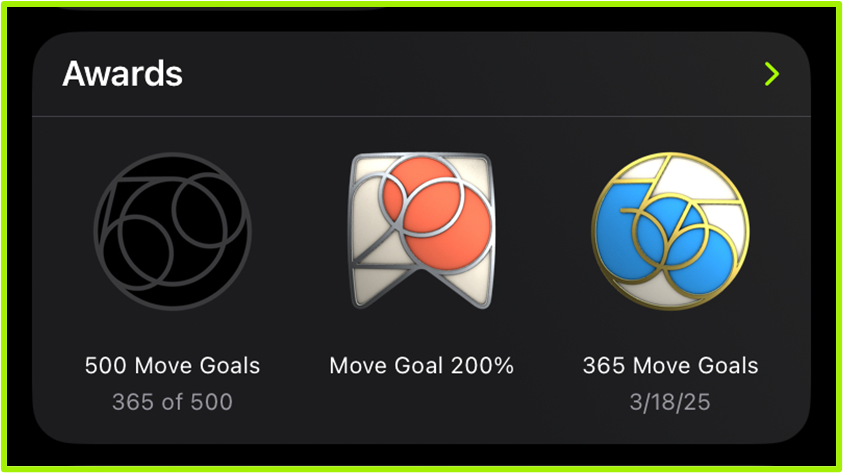
I didn’t ask for the Fitness App to be installed on my iPhone, but Apple put it there anyway. Not as sophisticated as when it is linked to an iWatch, it nevertheless keeps track of my movements during the day, especially when I am out on my morning run. At some point several years ago, apparently around the iOS 14 upgrade and unbeknownst to me, the app set some goals for my daily calorie burn. It seems Apple knows enough about me to think it has an idea of how active I ought to be. And then, to encourage my submission to its dictates, the app offers me awards, “digital equivalents of enamel pins or badges.” I earned a badge for meeting or exceeding my goal 365 times, but as soon as I did it upped the ante to 500 times. I’ve got a fake enamel pin for the number of times I have exceeded my goal by 200%, and another for all my perfect weeks. Apple says I ought to challenge my friends to an awards competition. Private message me and I will decline your dare.
So, an app I did not want measures me against standards I did not set. And I am checking those pins and badges all the time.
Now, this could be a rant against invasive and manipulative technology, and invasive and manipulative technology deserves all the rants we can give it. But I want to turn a different direction at this intersection.
We might say that in a way God has created us with a longing for which we did not ask. This longing is at times invasive and can seem manipulative. Blaise Pascall spoke of a hole, a vacuum, a great abyss in the human heart. “This infinite abyss can be filled only with an infinite and immutable object; in other words, by God himself,” Pascall writes. Augustine famously confesses, “Our hearts are restless till they find their rest in Thee.”
Seeking God – the infinite abyss to be filled, the restless heart to find its rest – we encounter measures we cannot meet, standards we will never achieve, commandments that are absolute and impossible to obey all the time. We are called to be holy but find holiness to be unattainable.
The Heidelberg Catechism (Question 114) asks, “Can those converted to God obey these commandments perfectly?”
The answer: “No. In this life even the holiest have only a small beginning of this obedience. Nevertheless, with all seriousness of purpose, they do begin to live according to all, not only some, of God’s commandments.”
“O wretched man that I am! Who shall deliver me from this body of death?” the Apostle laments to the Romans (7:24).
Were my goal perfect obedience with a digital pin as my reward, my heart would remain restless, the abyss unfilled. But such perfect obedience, such meeting of impossible goals, such submission to an invasive and manipulative other, is not my purpose in life, and I find that comforting.
In the words of Heidelberg Question 1, my only comfort in life and death is “that I am not my own, but belong—body and soul, in life and in death—to my faithful Savior, Jesus Christ. He has fully paid for all my sins with his precious blood and has set me free from the tyranny of the devil. He also watches over me in such a way that not a hair can fall from my head without the will of my Father in heaven; in fact, all things must work together for my salvation. Because I belong to him, Christ, by his Holy Spirit, assures me of eternal life and makes me wholeheartedly willing and ready from now on to live for him.”
I did not ask for a restless heart, and I have but a small beginning of obedience to the holy standards that have been set for my holiness. But I have been assured of eternal life and have been made, not of my own effort, wholeheartedly willing and ready to live for Christ. Thanks be to God.