
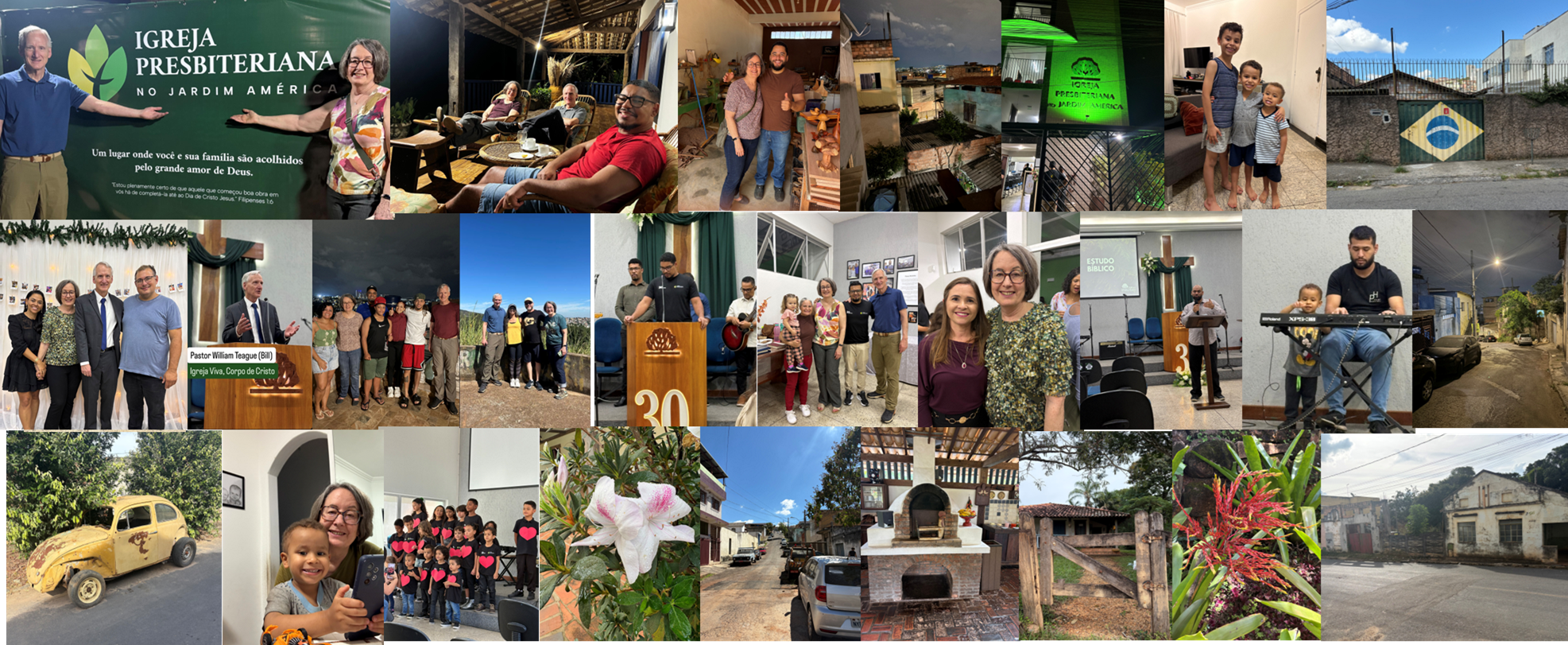
We are back from Brazil. The collage of photos is an incomplete chronicle of the trip, each photo telling a story – some of those stories are reminders of wonderful things in the past, and some point forward to relationships and works that may yet come.
Those reminders of the past are rooted in the many short-term mission trips to Brazil we were able to take over many years. Wonderful trips.
While the short-term missions phenomenon has not yet spent itself, it may not be as robust as it was prior to the pandemic. From the 1990s through the 2010s, short term trips were at the heart of many American churches’ mission outreach. Youth and adults alike would raise vast amouts of money, book passage to some foreign country and spend a week running a Vacation Bible School for the kids they found in the villages and towns of the foreign country, painting the building of their host church, or passing out evangelistic tracts to people whose language they did not speak. It felt so good to help those poor people, and feeling good is what American Christians are all about. Pastors would drop in for a week of training indigenous church planters and return home with a PowerPoint presentation for their sending congregation showcasing the amazing effectiveness of their teaching. Bragging rights never end.
Ten years ago, the Chalmers Center, an organization dedicated to helping churches do a better job with mission work, especially short-term mission, produced a cutting satirical video on the worst of short-term mission trips. It is worth watching again. (The center produced what is still one of the best resources on congregational mission, the book When Helping Hurts and associated materials [again, worth watching].)
How bad were many short-term mission projects? Pretty bad. I should know; I was an enthusiastic practitioner.
In order to ameliorate some of the worst aspects of short-term missions, we often spoke of “short-term mission with a long-term commitment.” To be sure, the joy we experienced in visiting with friends we have known and loved for over two decades is due to long-term commitments both here in the United States and among our Brazilian brothers and sisters. With few apologies, we are able to say that God used our partnership for his good purposes in our lives and in their lives. Short-term mission with a long-term commitment.
 But there is another photo from our trip that reminds us of a very short-term trip with no long-term commitment. In 2001, 2002, and 2003, our mission teams visited a little farm town an hour or so outside of Belo Horizonte, the city of our long-term commitments. For one afternoon we Americans ran Vacation Bible School (EBF – Escola Biblica de Férias) at the Presbyterian church in Florestal. Drop in and drop out. After three years it got to be too much to do, and so we quit doing it. Short-term, no commitment.

We spent this past weekend with friends from Belo Horizonte at a hotel fazenda (ranch resort) near Florestal. We had been there before. It was good to be back. On Saturday afternoon Becky and I decided to take the mile and a half hike into town, and while there we wanted to walk past the Presbyterian church. Long story short, we met the pastor and a young woman who was a child when the Americans came with their EBF. She remembered those days in July 20-plus years ago. She told us that her experiences in EBF were one of the reasons she kept coming back to the church until she was old enough to make a commitment to Christ and his church. We dropped in and dropped out, but God kept working in her life.
How bad were those short-term mission trips that were so popular in the American church from the 1990s to the 2010s? Many of them pretty bad. But what a joy to see that God used even our drop-in, drop-out trips to Primeira Igreja Presbiteriana de Florestal for his good purposes.