09.25.2020 – Our Hideous Addiction

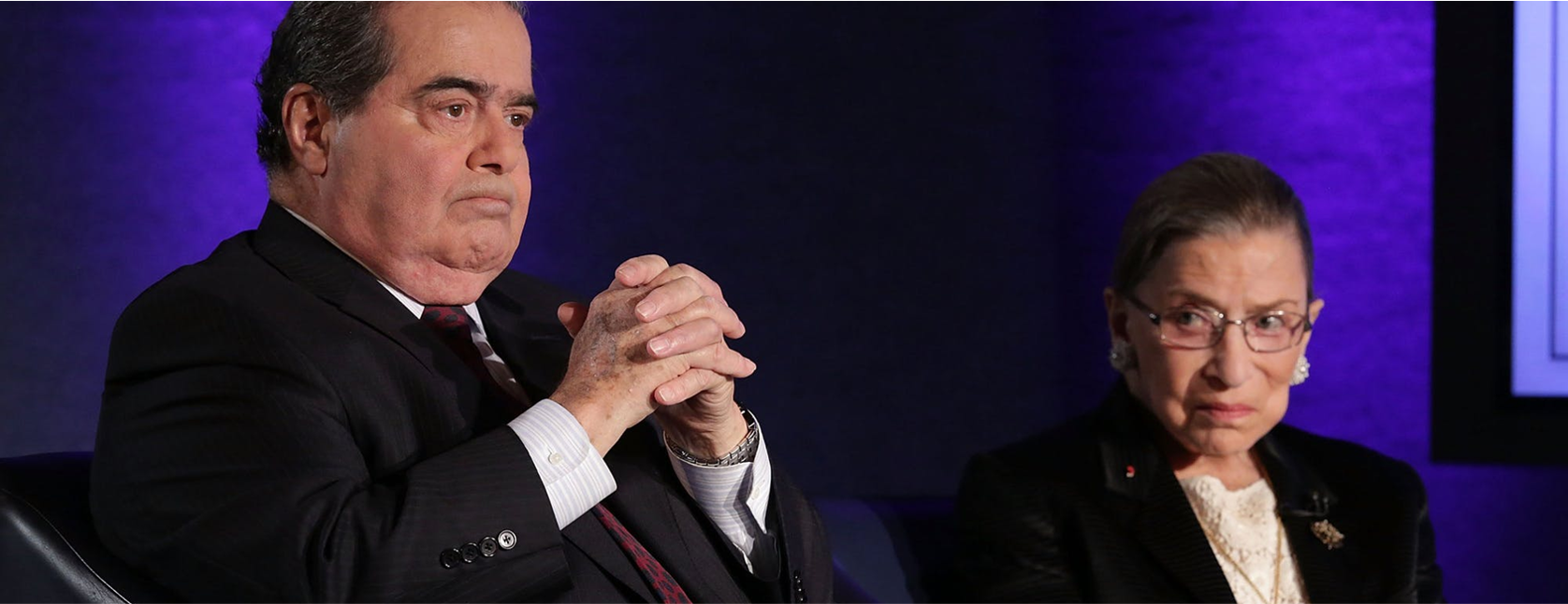
The death of Supreme Court Justice Ruth Bader Ginsberg has by all accounts exacerbated the deep divides in our country and culture.  But the vitriol has not buried all that can be said and should be remembered about Justice Ginsberg.  Among the worthy memories of a remarkable life have been not a few stories of her friendship with Justice Anton Scalia whose death four yeas ago was also an occasion for political maneuvering and partisan animosity.

Ginsberg and Scalia were often on opposite sides of the opinions of the court, she writing scathing dissents of opinions written by Scalia and he returning the favor when she wrote for the majority.  Scalia famously said of Ginsberg, “She likes opera, and she’s a very nice person. What’s not to like? Except her views on the law.” And Ginsberg of Scalia, “I disagreed with most of what he said, but I loved the way he said it.”

Ginsberg was asked to write the forward to a collection of Scalia’s speeches published after his death. She wrote, “If our friendship encourages others to appreciate that some very good people have ideas with which we disagree, and that, despite differences, people of goodwill can pull together for the well-being of the institutions we serve and our country, I will be overjoyed, as I am confident Justice Scalia would be.” Continue reading
09.18.2020 – Much Ado About…Something

The news story was about something else – a church that has refused to abide by local regulations banning indoor services during the pandemic.  We can talk about that some other time. Or maybe not.

It was a sentence at the end of the story that caught my eye and got me to thinking.  It was not much more than an afterthought.  It was as if the reporter remembered one more thing he wanted to say. The third from the last paragraph read:“According to (the pastor), the church regularly welcomes over 7,000 guests to Sunday Service.”

Much ado about nothing?  Maybe.  A reporter’s (or a pastor’s) poor choice of words? Perhaps.

Churches ought to be welcoming. 7,000 is a few too many for me, but some people like big churches. No need for much ado about that. It is the description of those who come on Sunday as “guests” that bugs me.  Poor choice of words or not, that’s one of the things that’s wrong with the American church.  We act as if we’re guests. The host (not what you liturgical types are thinking) owes me a good show.  I come to be served and entertained. I hope your chairs are comfortable and your music according to my tastes. Pastor, please confirm my biases and preferences in what you say.

Lord, save me from a church where those who gather are seen as guests. Continue reading

09.10.2020 – When Death Comes Near

This week’s edition comes a day early for reasons that will be apparent after you have read the post. – BT

The words of two young men.  They are near the same age, one 29 and the other 31. Both are loved by their families and friends. Both have walked deep into the cold shadow of death.  Both speak of what they have seen.  There are differences between the two young men, as well.  Elliot, 31, a Brit, has lived a privileged life, is articulate and successful. He has traveled the world. Jacob, 29, an American, has, by his own reckoning, struggled to succeed. His words do not flow smoothly.  His world is small, limited by the circumstance of birth and race and choices he has made.  Elliot is white. Jacob is black.

Elliot will die soon, perhaps within a few weeks. Jacob will live, perhaps, though, as a paraplegic.

Most of us know a little about Jacob Blake, the 29-year old American who was shot in the back during an altercation with the police in Kenosha, Wisconsin.  I first heard about Elliot Dallen when I read his eloquent essay in the Guardian a couple of days ago. At 31, I have just weeks to live. Here’s what I want to pass on.  I have been thinking about it ever since.

I encourage you to stop now and read Elliot Dallen’s piece.  1,800 words; it won’t take long. But you may pause to think for much longer than it takes to read what he writes. Continue reading

09.04.2020 Canceled by Google!

The long arm of Big Tech has touched our unassuming lives. We have been canceled. We don’t exist. If the oligarchs of Silicon Valley have their way, we will simply cease to be.

For years we lived under the thumb of Big Tech, compromises here and there, but we never thought they’d come for us.  Sure Mark Zuckerberg kept track of our every “like,” and Google maintained a long list of searches and page visits. They told us all our passwords were safe from malicious intruders, and we believed them.  We trusted them, and figured those annoying targeted ads were a small price to pay for access to the world wide web and our friends’ cute pet videos.

Then they came for us. We don’t know if it is personal, something we have done; maybe an opinion we expressed. We do know they are telling the world, our world, that we no longer exist. We don’t count; we don’t matter. Continue reading

08.28.2020 – Habits of Daily Schedule and Habits of the Heart

The shooting of Jacob Blake in Kenosha, Wisconsin, this past Sunday and the nation-wide reaction to it serve as painful reminders that the American dream of liberty and justice for all has yet to be fully realized, and no more so than for the Black community.

We pray fervently in this case as in the too many others of this summer of our discontent that the decisions of review boards and courts, judges and juries, will open wide the floodgates through which justice might roll down like waters and righteousness like an ever-flowing stream (Amos 5:24).

To be sure, our dedication to the proposition that all people are created equal must work itself out in new and changed public policies, with the writing of just laws, and in reimagined and rebuilt systems of opportunity and access to the bounty of our land. But that the prayer of the old hymn might be realized – our gold refined and the mending of our every flaw – will require, too, in the words of Alexis de Tocqueville borrowed by sociologist Robert Bellah, new habits of the heart. Continue reading