
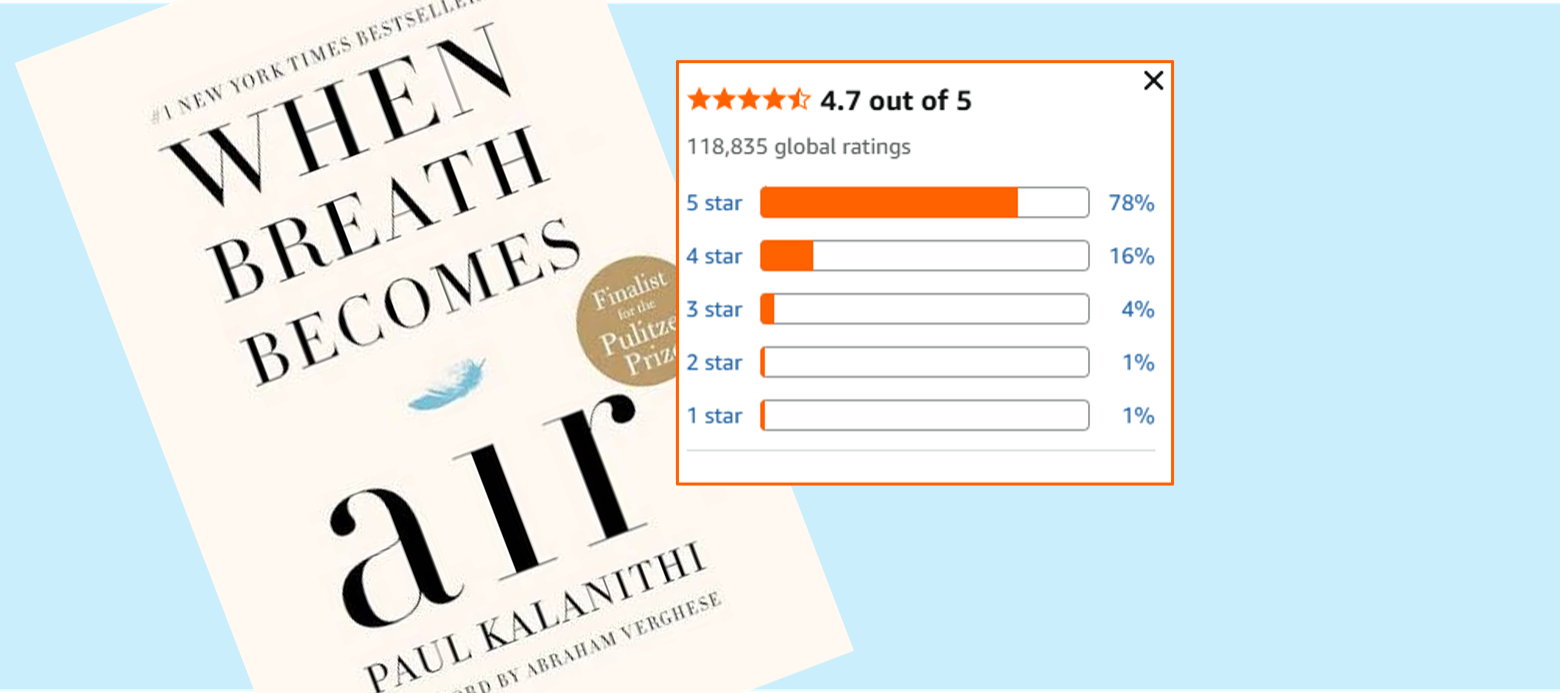
The book made its headlines ten years ago, but I just read it this week after reading an essay that mentioned it. The Amazon page from which I ordered “When Breath Becomes Air,” quoted a New York Times review describing the book as ““Unmissable . . . Finishing this book and then forgetting about it is simply not an option.” I will not forget about it.
The dust jacket of “When Breath Becomes Air” identifies the book as a finalist for the Pulitzer Prize. The Pulitzer nominees page describes the setting for Paul Kalanithi’s writing, “At the age of thirty-six, on the verge of completing a decade’s worth of training as a neurosurgeon, Paul Kalanithi was diagnosed with stage IV lung cancer. One day he was a doctor treating the dying, and the next he was a patient struggling to live.” The book is the story of Kalanithi’s first 35 years of life – his growing up years and his decision to become a neurosurgeon, and of his last 20 months of living with and then dying of cancer.
“When Breath Becomes Air” was not the first in the genre of death journals, nor of the genre of a physician becoming the patient. With its fine writing and deep insights both into medicine and the search for meaning in life, it may be one of the best of either genre. The book is not a “Christian book” by any means, but Christian faith is present and real as Kalanithi seeks the meaning of life and of death.
I recommend the book without hesitation. Because it is ten years old, the hardcover edition is actually cheaper than the Kindle version. Buy it! Go to your local library and check it out!
But something else has got me thinking. Before ordering the book, I checked several reviews from a variety of sources and perspectives: the New York Times, the Guardian, The Wall Street Journal, the Christian Century, Christianity Today, and the Gospel Coalition among others. All of them praised the writing and work.
It is a good book.
I wondered, then, about those 2% of Amazon readers among nearly 120,000 who rated it with just a star or two. What did they find so objectional? I read some of the one-star reviews. A few of them can be dismissed as complaints about a torn dusk jacket or late delivery. Others commenting about Kalanithi’s ethnicity or faith deserve no attention. Among the others, however, it often boiled down to opinion – “I would not have used that vocabulary,” “I didn’t like the medical details – or the philosophical pondering,” “I would not have made the decision he made.” In fact, “I would not have died the way he died.”
Who cares?
Online reviews are part of our lives. Everyone from the plumber to the doctor wants one. The “how did we do?” text often arrives before you have the car back from the mechanic.
Now, in some ways, every review is an opinion. In my opinion “When Breath Becomes Air” is a very good book. But not everything is a matter of opinion. By objective standards Paul Kalanithi’s use of the English language is superb. By the high standards of Yale and Stanford medical schools, Kalanithi was a gifted physician. By the standards of historic orthodoxy, his journey to death’s door was faithful and good.
Yes, we all have opinions. I can tell you what in my opinion is the best Mexican restaurant in Fort Wayne, Indiana (4.6 stars on Google Reviews). You may not like it.
We live in a world where opinion has become truth. The internet is full of opinion and little truth, however. Clever memes and angry influencers are the arbiters of reality.
“When Breath Becomes Air” is a good book. It is also a true book. I may not die the same way Paul Kalanithi died, but I hope I die as well.
Forgetting the story told in “When Breath Becomes Air” is not an option. But I hope also to remember the importance of seeking truth over opinions, especially my own opinions.