
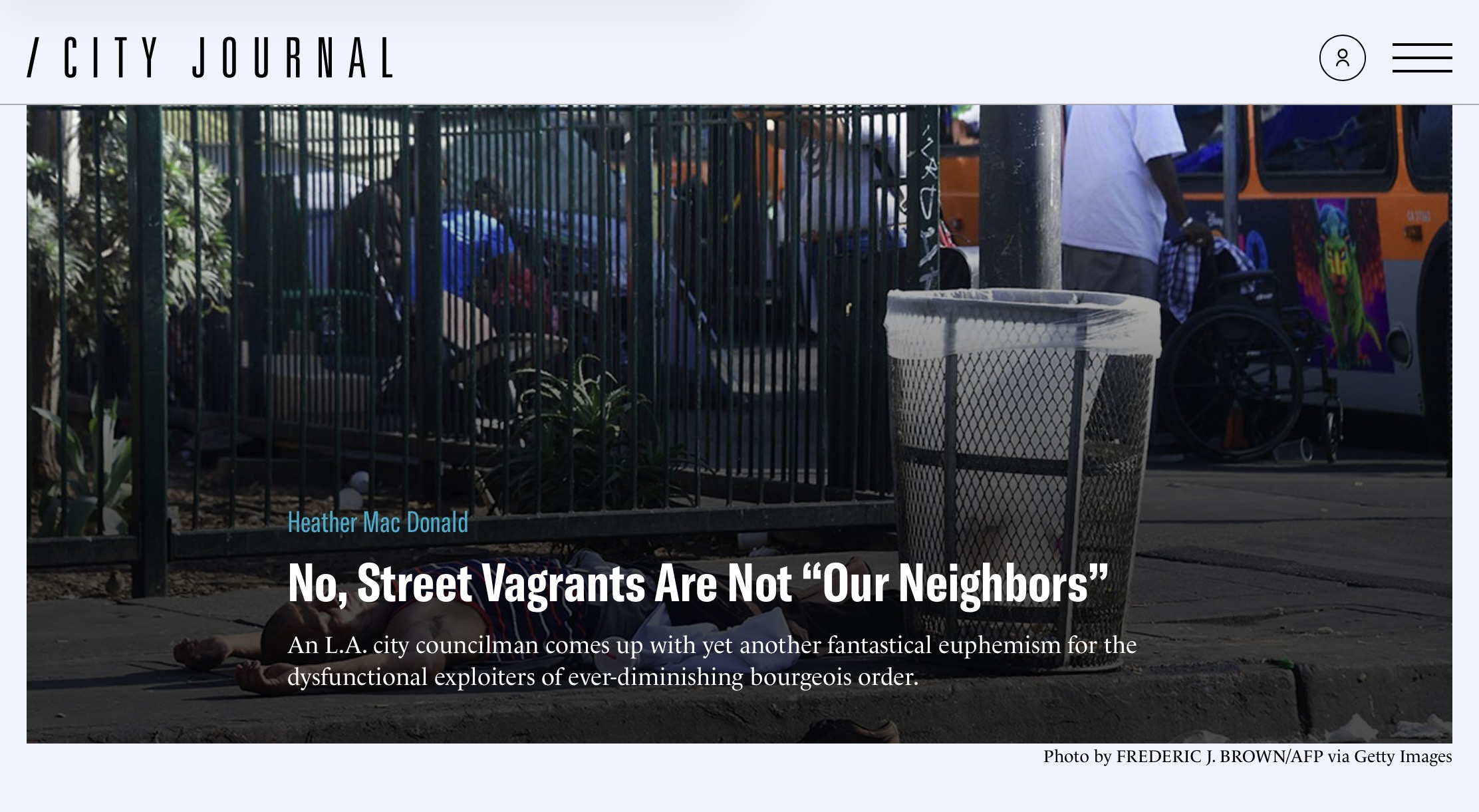
Screenshot
The headline on my newsfeed caught my eye. “NO, Street Vagrants Are Not ‘Our Neighbors’.” But they probably are.
The article had to do with policies regarding the homeless in Los Angeles. An apparently newly-elected city council member and Democratic Socialist used the term “neighbors” in arguing for a new, and arguably more lenient, policy regarding homeless encampments. Now, you can count me out when it comes to the growing support for the Democratic Socialists. My guess is that we are going to find the “warmth of collectivism” as cold as the wait for a Siberian spring.
After deciding I disagreed with the headline, I read the article.
The “not our neighbors” line was not clickbait set as a lure to entice curious fish; it was the heart of the post. The columnist wrote:“Neighbor” traditionally conjures the image of someone with an equal stake in one’s community as oneself, who shares one’s interest in stability, and who can be counted on, in times of need, for help. The occupants of the feces- and drug-strewn trash sites euphemistically referred to as “encampments,” as if they were part of a Boy Scout Jamboree, don’t fit the bill. Those transients are parasites on other people’s efforts to create a community. They contribute nothing, pay no rent or taxes, and inevitably bring lawlessness and predation. They almost invariably turn down the shelter and services offered by feckless outreach workers, since they want no interference with their unrestricted drug use.”
While these are the most incendiary words in the piece, I do not disagree with all the author wrote. Even if the homeless frequently “contribute nothing, pay not rent or taxes, and inevitably bring lawlessness and predation,” however, they are still our neighbors. Jesus said so.
When a lawyer asked Jesus to define who is a neighbor and who is not, Jesus responded by telling him a story about a man on the road to Jericho who was mugged and then helped by a passerby who happened to be a hated Samaritan. You may remember the story. As Bible scholar Kenneth Bailey says, the lawyer’s conventional wisdom held that “Gentiles are not neighbors and everyone knows God hates the Samaritans, so they certainly do not qualify as neighbors.” Commentator Norval Geldenhuys summarizes his thoughts on the Parable of the Good Samaritan by writing, “Jesus teaches explicitly that love for one’s neighbor knows no bounds of nationality or of anything else, no matter what.”
I have little confidence in the ability of warm collectivism to free people from feces- and drug-strewn trash sites. Or to free me from a definition of neighbor that is limited to people just like me. But Jesus tells us to love our neighbors as ourselves and that by abiding in his word, we will know the truth and the truth will set us free (John 8:31-33).
Yes, street vagrants are our “neighbors,” and we love them by caring for them and by sharing God’s love and freedom-bringing word with them.