
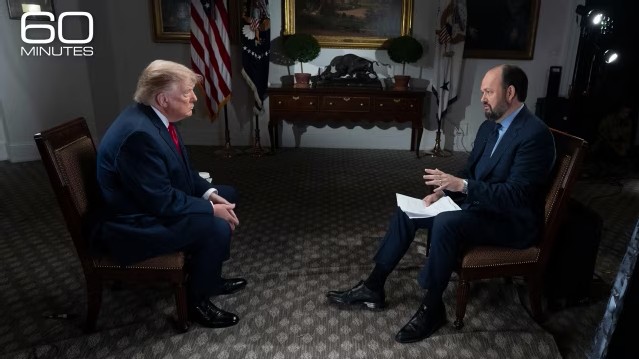
Lost in the news cycle dominated by computer outages and Kate Middleton’s snub of Harry and Meghan as she sent invitations to her annual Christmas party, was President Trump’s 60 Minutes interview with Ross Douthat. While much attention has been given to the president’s comments on the mid-term election and his assessment of the first two years of his second term, I was most fascinated by how the interview ended. A full transcript of the interview as broadcast is available here.
Having talked about the potential and the threat of artificial intelligence, the conversation first turns to UFOs and then to death and forgiveness. Douthart asks the president what he thinks happens when you die.
“You mean where do I go?” Mr. Trumps asks. “Exactly,” Mr. Douthat responds.
“Well, I am a religious person, so in theory I go to heaven, … I hope so. I don’t want to go to hell,” the president answers.
Mr. Douthat reminds Mr. Trump of a previous comment the president made regarding his struggles with the idea of forgiveness. He offers a scenario: “Let’s say you pass away, you’re entering the next life, and all you have to do to enter paradise is feel love and forgiveness for James Comey, Nancy Pelosi, anyone who you have expressed hate for over the years. Do you think you can do it?’
Here’s the give and take:
President Donald Trump: Well, then I wouldn’t be real, would I? I mean, if I said to you, sure, the easy answer to that is “Oh, yes, I could forgive.”
Ross Douthat: Is the answer no then?
President Donald Trump: The answer is no. I want to be honest, no.
Ross Douthat: Before the judgment throne of God?
President Donald Trump: Before the judgment. No, I think they were very bad people and– I dislike, I can use the word hate, I do hate some of my enemies. I think they’re– they’ve been terrible. Look what they’ve put me through, the weaponization. I got indicted— I mean, it’s such an easy answer. All I have to do is say, “Yes, I can.”
Ross Douthat: I– I, again, I don’t think it’s an easy answer–
President Donald Trump: Honestly, Ross, can I– can I be honest–
Ross Douthat: –that’s why I asked it. Yes.
President Donald Trump: I probably cannot do that, no, because I do hate some of my enemies and I always will.
To the extent that they have commented, the president’s political opponents have been critical of the president’s non-forgiving attitude. The best his supporters come up with is, “At least he’s honest.”
The president identifies as being a religious person, maybe a Christian, though his answers don’t indicate much by way of spiritual or Biblical formation. Like a majority of Americans, the president “hopes” he will go to heaven. Grace just may not be amazing enough, though. Nor has it taught his heart to fear. If forgiving others, even enemies, is the price of eternal joy, the president seeks something else his fears to relieve.
Now, while it is objectively clear that the president’s understanding of the gospel is less than theologically robust or personally transforming, his standing before the throne of God is not mine to judge.
The 60 Minutes interview, however, has pushed me beyond political or pastoral commentary. “What about me?” I wonder. Am I able or have I forgiven my enemies? Note that Jesus does not deny the existence of enemies but calls his followers to love and forgive those who are our enemies. (Read the Sermon on the Mount, Matthew 5-7)
So, have I, will I, forgive those who have made my life difficult by what they may have said or done? “They didn’t mean it,” “You’re too sensitive,” “Maybe they had a point,” or “It was just a personality clash” won’t cut it. The harm was real and sometimes meant, and that is what makes forgiveness so difficult. And what about those I have harmed?
Can I forgive? The easy answer is, “Oh, yes, I can forgive.” Honestly, like the president I can’t. But by amazing grace I can. “I can do all things through him who strengthens me,” the Apostle tells the Philippians. Even forgive. Amazing grace, how sweet the sound.