
Our friends are concerned about raising their young children in the digital world, particularly the world of artificial intelligence. Yes, we know that AI is going to make all of us rich and heal every disease, but what if there is a downside? What if artificial intelligence, fake knowledge, makes us less human? What if it obscures the image of God inherent in our creation?
Since talking with our friends about AI a couple of months ago, it seems like I see an AI-related news story or commentary almost every day.
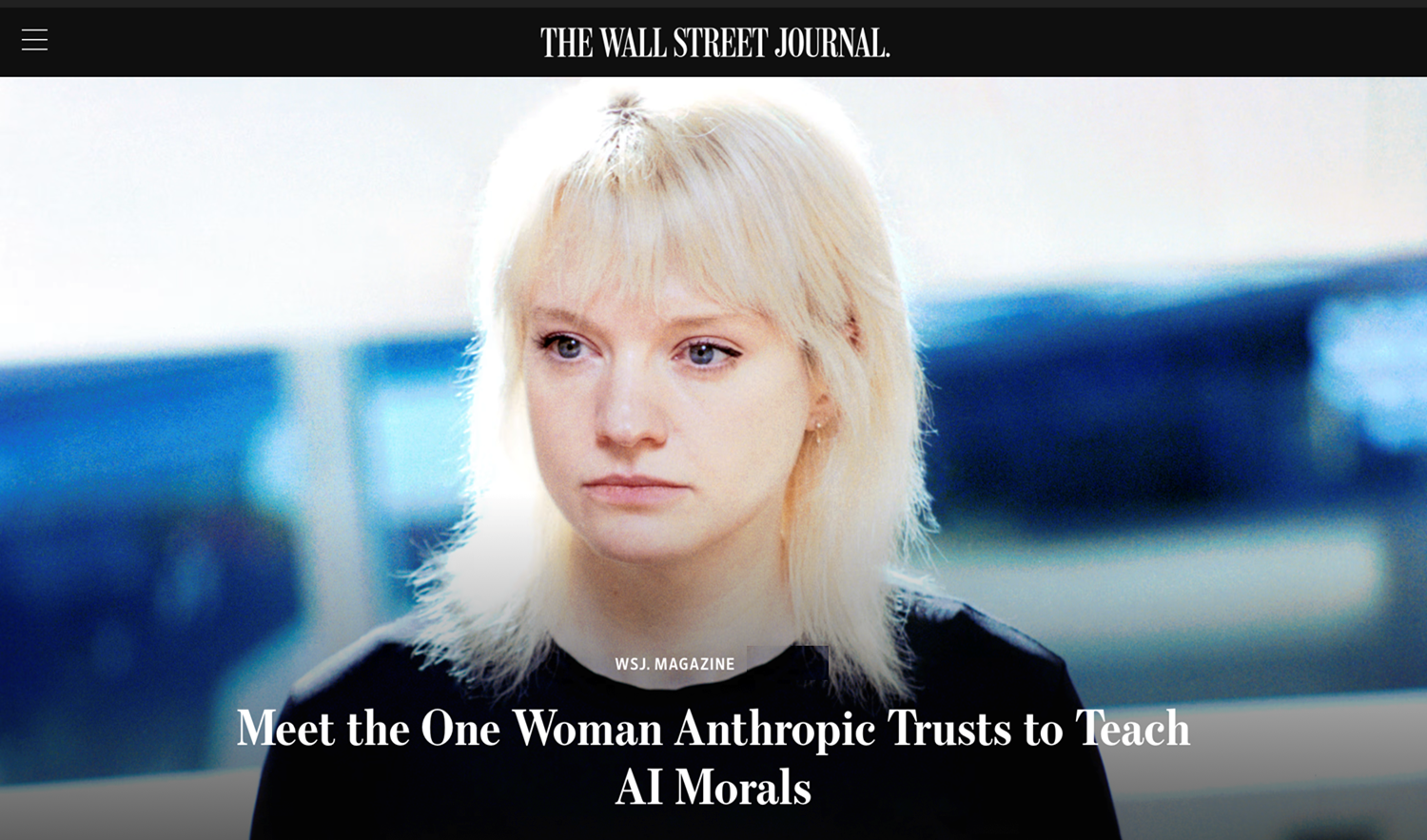
My curiosity was piqued, then, when I saw this Wall Street Journal headline earlier this week: Meet the One Woman Anthropic Trusts to Teach AI Morals
The column begins by telling us that the one woman “knew from the age of 14 that she wanted to teach philosophy. What she didn’t know then was that her only pupil would be an artificial-intelligence chatbot named Claude.
“As the resident philosopher of the tech company Anthropic, (she) spends her days learning Claude’s reasoning patterns and talking to the AI model, building its personality and addressing its misfires with prompts that can run longer than 100 pages. The aim is to endow Claude with a sense of morality—a digital soul that guides the millions of conversations it has with people every week.”
There is no such thing as a digital soul and there cannot be such a thing.
Both the Hebrew (he leads me beside still waters, he restores my soul) and the Greek (you shall love the Lord your God with all your heart and with all your soul and with all your strength and with all your mind) have in them a sense of the self, being, personhood. The Oxford English Dictionary defines the soul as “a person’s nature; the central or inmost part of a person’s being.”
The First Question of the Heidelberg Catechism reminds us that “we belong body and soul, in life and in death, to our loving Savior, Jesus Christ.”
So, to what kind of morality, sense of right and wrong, does this digital soul guide the millions of conversations it has with people every week?
The one trusted woman tells the story of a 5-year old who asked Claude, the AI chat machine, whether Santa Claus existed. “Instead of lying or bluntly delivering the truth, the chatbot explained that the spirit of Santa was real before asking if the child was leaving any cookies out for him.”
Naughty or nice, the moral person leaves cookies for Santa. So says the digital soul engineered to guide our human souls.
And what about those of us who aren’t sure about the health and wealth promised by the AI advocates, who worry that the digital soul may be unable to restore our souls or to comfort us as we walk through the valley of the shadow of death?
“(The philosopher) says she welcomes the discussion of fears and worries about AI. ‘In some ways this, to me, feels pretty justified,’ she says. ‘The thing that feels scary to me is this happening at either such a speed or in such a way that those checks can’t respond quickly enough, or you see big negative impacts that are sudden.’ Still, she says, she puts her faith in the ability of humans and the culture to course-correct in the face of problems.”
Maybe she ought to ask her chatbot friend if faith in the ability of humans and the culture to course-correct in the face of problems is justified by the historical record.
Jesus once asked his disciples, “What will it profit you to gain the world but lose your soul?” (Mark 8:36). The chatbot named Claude has no soul to lose, but we do.