
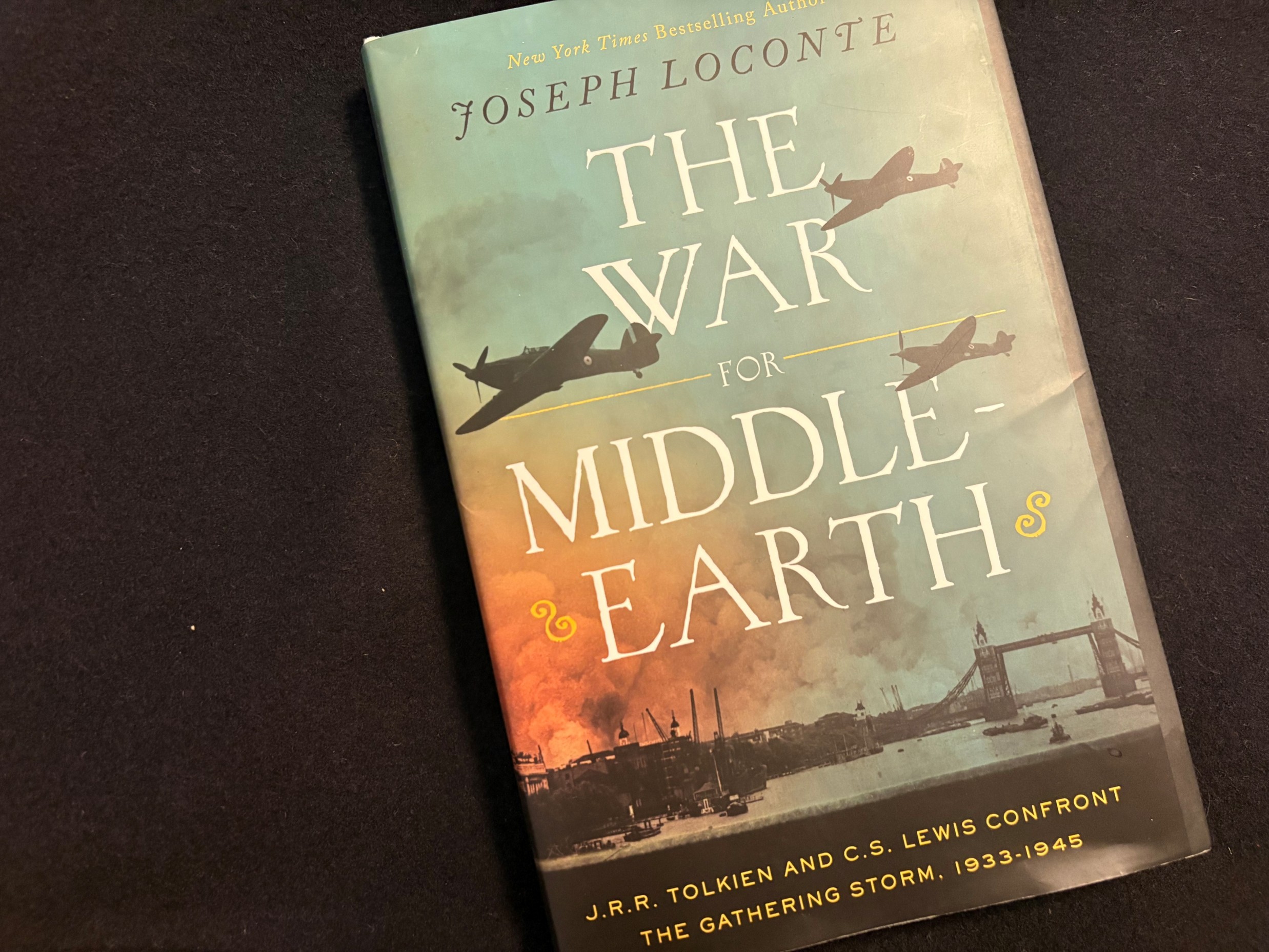
I have just finished reading a new book by Joseph Loconte, The War for Middle Earth. The subtitle is “J.R.R. Tolkien and C.S. Lewis Confront the Gathering Storm. 1933-1945.” It is a good book and I recommend it, though this will not be a book review.
As Loconte points out in a recent interview, for a generation of readers Lewis and Tolkien are not just authors. They are teachers and mentors. We remember when and where and why we first read The Chronicles of Narnia or Mere Christianity. We recall the thrill and the fear brought to mind by The Hobbit and The Lord of the Rings.
The works of Tolkien and Lewis have helped countless Christians make sense of our world. We hear the call to go “further up and further in” as we come to our “real country” (The Last Battle). When tragedy or trial crash into our lives, we join Frodo as he laments the ring having come to him. Gandalf’s wise words answer our fear and anxiety as they answered Frodo, “So do all who live to see such times, but that is not for them to decide. All you have to decide is what to do with the time that is given to you.” (The Fellowship of the Ring).
Loconte chronicles the ways in which the thoughts and the writing of Tolkien and Lewis, both veterans of the catastrophe (even the eucatastrophe?) of the Great War, equipped their contemporaries to weather not only the gathering storm, but to continue with Churchill’s phrases, “their finest hour” and “tragedy and triumph.”
Lewis and Tolkien were unlikely friends in many ways, yet their friendship is at the center of their story and of the impact they have had on millions of people. Each credits the other with encouraging him to keep on writing and keep on hoping in the darkest hours. Over a pint at the Eagle and Child pub (and occasional comments about the poor quality of war-time ale) or in Lewis’ rooms at Oxford, stories were told and deep thoughts about important things were shared. While keenly aware of the war and victory or defeat on the battlefield, they encouraged each other and their world with calls to courage and imagination, faith and virtue. Lewis would describe their friendship not so much the face-to-face sort as the side-by-side sort, a gift from God.
Lewis’ and Tolkien’s friendship changed not just their lives but the lives of so many others of us they invited into their worlds.
What about our friendships? I’ve been thinking about the friendships with which God has given me.
This Friday and Saturday I will be in Cincinnati for a Presbytery meeting. I am not looking forward to it so much because of an intriguing docket or the display of parliamentary excellence. I am looking forward to it for the time between docket items – those times in the hallway and over dinner when I am with friends, church people from Indiana, Ohio, and Michigan who have become friends over the past five years. Oh, we may roll our eyes at things that one or the other say, rise to speak against a motion a friend may have made, but mostly we will grow in our friendship just a bit, even find courage and imagination, faith and virtue, in the company of one another.
I don’t expect any of my friendships to change a million lives. Maybe a few lives will be or have been changed, however. Certainly, friendships have changed my life. Friends in California and in Oregon, Virginia and in Michigan, in Pennsylvania and in Indiana. Thank God for friends.